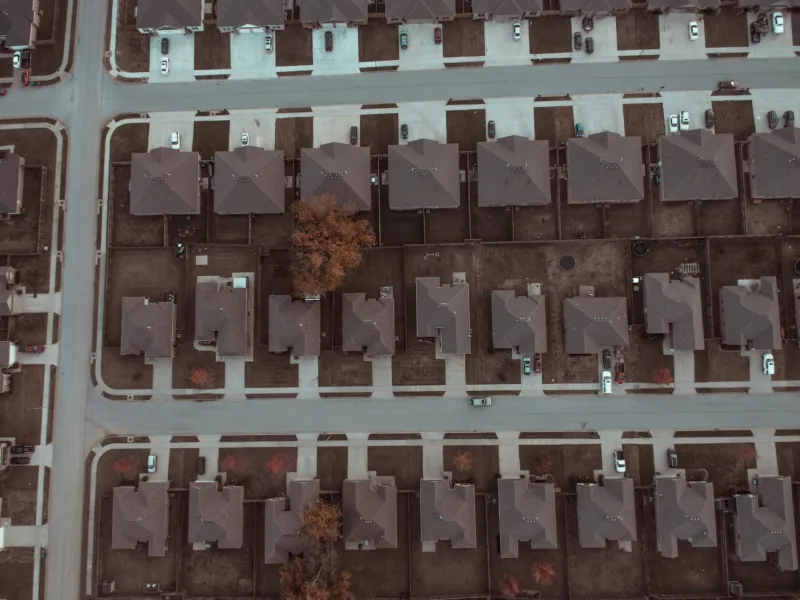
The Biden administration has found a new weapon in its war on suburban America: the promise of "affordable housing." Through a maze of federal regulations, HUD mandates, and financial coercion, Washington bureaucrats are systematically dismantling local zoning authority and forcing high-density development into communities that never asked for it.
The Federal Housing Takeover
At the center of this assault is the Affirmatively Furthering Fair Housing (AFFH) rule, a Obama-era regulation that the Biden administration has weaponized beyond recognition. Originally designed to address historical discrimination, AFFH has morphed into a federal sledgehammer against single-family zoning. The rule essentially forces municipalities to prove they're promoting "fair housing" by eliminating what HUD considers exclusionary practices—which increasingly means any zoning that preserves neighborhood character.
The mechanism is elegant in its simplicity: accept federal housing dollars, or lose them unless you comply with Washington's vision of what your community should look like. For cash-strapped municipalities dependent on federal grants, it's extortion dressed up as social justice.
The Biden administration has doubled down on this approach, with HUD Secretary Marcia Fudge openly calling single-family zoning a "relic of segregation." The department has made clear that communities seeking federal housing assistance must demonstrate they're actively working to increase housing density—regardless of local preferences or existing infrastructure capacity.
The Property Rights Massacre
What we're witnessing is nothing less than the federal government's hostile takeover of the most fundamental aspect of local governance: land use. For over two centuries, zoning decisions have been the exclusive domain of local communities. Residents could attend town halls, voice concerns, and directly influence how their neighborhoods developed. That democratic process is being systematically dismantled by federal bureaucrats who've never set foot in these communities.
The constitutional principle of federalism isn't just an abstract legal concept—it's the foundation that allows different communities to reflect different values and priorities. A rural town in Montana should be able to preserve its character without Washington's interference, just as an urban neighborhood should be free to pursue density if residents choose.
But under the current federal housing regime, local preferences are irrelevant. Communities are being forced to accept developments that strain infrastructure, overwhelm schools, and fundamentally alter neighborhood dynamics. Property owners who invested in single-family neighborhoods based on existing zoning protections are watching their investments—and their communities—transform overnight.
The Affordability Fraud
The cruelest irony is that these federal mandates aren't actually making housing more affordable. Cities that have eliminated single-family zoning under federal pressure haven't seen meaningful decreases in housing costs. San Francisco, which has aggressively pursued density mandates, remains one of the most expensive housing markets in the nation. Seattle's upzoning efforts have coincided with skyrocketing rents, not relief for working families.
 Photo: San Francisco, via eskipaper.com
The fundamental problem isn't zoning—it's supply restrictions created by excessive regulation, permitting delays, and environmental reviews that can stretch for years. A single-family home in Texas costs a fraction of what it does in California, not because Texas has eliminated suburbs, but because Texas has eliminated regulatory barriers to construction.
The Real Solution: Deregulation, Not Coercion
Genuine housing affordability comes from unleashing supply-side forces, not federal micromanagement. States and localities that have streamlined permitting, reduced regulatory burdens, and eliminated arbitrary construction delays have seen housing costs stabilize or decline. The market works when government gets out of the way.
Republican governors in states like Florida and Texas have demonstrated this approach. By cutting red tape, expediting approvals, and reducing regulatory compliance costs, they've maintained housing affordability without sacrificing local control or suburban character. These states are seeing population growth precisely because families can still achieve the American dream of homeownership.
The federal government's role should be limited to removing barriers to interstate commerce and ensuring genuine civil rights protections. It should not include redesigning American communities according to the architectural preferences of HUD bureaucrats.
The Broader Political Stakes
This fight over housing policy represents a larger battle for the soul of American federalism. The Biden administration's approach treats local communities as obstacles to overcome rather than democratic entities deserving respect. It's the same centralizing impulse we see in education policy, environmental regulation, and countless other areas where Washington believes it knows better than the people who actually live in these communities.
The political implications are profound. Suburban voters who supported moderate Democrats are watching their neighborhoods transform without their consent. Parents who moved to specific school districts are seeing those schools overwhelmed by rapid development. These aren't abstract policy debates—they're personal violations of the basic democratic principle that communities should control their own destiny.
Republican candidates at every level should make this a central campaign issue. The choice is clear: local control versus federal coercion, democratic governance versus bureaucratic diktat, community preservation versus Washington social engineering.
Fighting Back
Several states have begun pushing back against federal housing mandates. Texas has passed legislation protecting local zoning authority from federal interference. Florida has created state-level protections for single-family neighborhoods. Other red states are considering similar measures.
But the ultimate solution requires federal action. Congress must pass legislation explicitly protecting local zoning authority from federal coercion. The next Republican president must immediately reverse the Biden administration's housing mandates and restore respect for local governance.
The stakes couldn't be higher: either we preserve the American tradition of local self-governance, or we surrender our neighborhoods to the whims of federal planners who view suburban America as a problem to be solved rather than a way of life to be protected.
The "affordable housing" lie has been exposed—it's time to defend the communities that make America great.