The 'Disinformation' Playbook — How the Federal Government Quietly Became the Internet's Biggest Censor
The First Amendment forbids Congress from making laws "abridging the freedom of speech." But what happens when the federal government doesn't make laws restricting speech — it just quietly pressures private companies to do the censoring instead? According to mounting evidence from court cases, congressional investigations, and leaked documents, that's exactly what's been happening across multiple federal agencies for years.
The Cybersecurity and Infrastructure Security Agency (CISA), the FBI, the CDC, and other federal entities have developed an elaborate system of "flagging" content to social media platforms, coordinating with academic institutions and non-governmental organizations to identify "misinformation," and applying pressure through regulatory threats and public statements. The result is a censorship apparatus that would make the Founders recoil — and it's all been done under the banner of protecting democracy.
 Photo: Cybersecurity and Infrastructure Security Agency, via www.shutterstock.com
The Twitter Files Pulled Back the Curtain
When Elon Musk released internal Twitter communications in late 2022, Americans got their first comprehensive look at how government censorship actually works in the digital age. The documents revealed regular communication between Twitter's content moderation teams and federal agencies, with government officials routinely flagging tweets for removal or suppression.
The FBI alone sent Twitter hundreds of requests to remove or restrict content, often involving political speech that had nothing to do with genuine national security threats. Agency officials didn't just suggest — they expected compliance. And they got it, with Twitter executives acknowledging in internal messages their need to maintain good relationships with federal regulators.
But Twitter was just the beginning. Similar patterns emerged across Facebook, YouTube, and other major platforms, all coordinating their censorship policies with federal agencies that have no constitutional authority to regulate speech.
Missouri v. Biden Exposes the Network
The most damning evidence came through discovery in Missouri v. Biden, a lawsuit filed by Republican attorneys general challenging government censorship. Court filings revealed a vast network connecting federal agencies, academic institutions like Stanford's Internet Observatory, and advocacy organizations — all working together to identify and suppress "problematic" content.
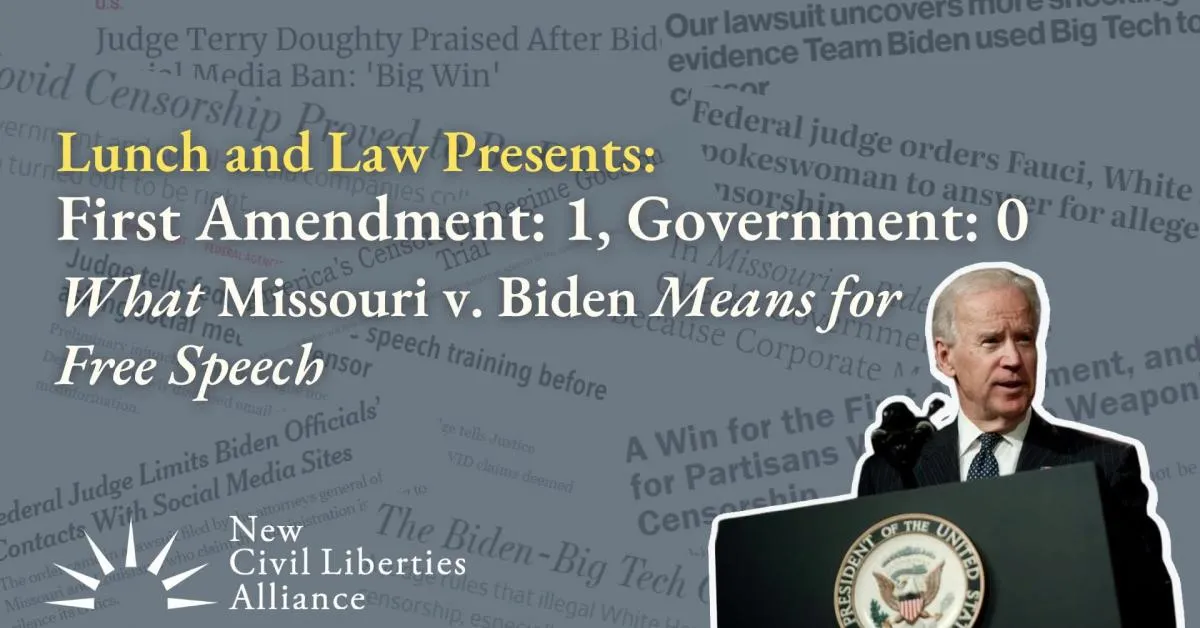 Photo: Missouri v. Biden, via justthenews.com
 Photo: Stanford's Internet Observatory, via nationalinternetobservatory.org
CISA, originally created to protect critical infrastructure from cyberattacks, had morphed into something resembling a Ministry of Truth. The agency developed partnerships with universities and NGOs to monitor social media for "mis-, dis-, and malinformation," then coordinated with platforms to have that content removed or throttled.
The targets weren't foreign propaganda or terrorist recruitment — they were American citizens expressing skepticism about COVID policies, questioning election procedures, or sharing politically inconvenient news stories. In other words, exactly the kind of political speech the First Amendment was designed to protect.
The Academic Laundering Operation
Perhaps most insidiously, federal agencies learned to launder their censorship through academic institutions. Universities like Stanford, NYU, and the University of Washington received federal funding to operate "disinformation" research centers that would identify problematic content and recommend action to social media platforms.
This created plausible deniability. When challenged, agencies could claim they weren't directly censoring anyone — they were simply funding academic research. The universities, meanwhile, could present themselves as independent scholars studying online harms. But the end result was the same: government-funded entities identifying political speech for suppression.
The Election Integrity Partnership, operated by Stanford's Internet Observatory, flagged over 4,800 URLs for content review during the 2020 election cycle alone. Many involved legitimate news stories about ballot harvesting, signature verification issues, and other election-related topics that voters had every right to discuss.
The Courts Push Back
Federal judges have increasingly recognized this censorship-by-proxy for what it is. In July 2023, Judge Terry Doughty issued a preliminary injunction in Missouri v. Biden, prohibiting federal agencies from coercing or significantly encouraging social media platforms to remove content.
Doughty's ruling was scathing: "The United States Government seems to have assumed a role similar to an Orwellian 'Ministry of Truth.'" He found that the government had likely violated the First Amendment through its coordination with social media platforms.
While higher courts have modified the scope of that injunction, the legal momentum is building against government censorship. The Supreme Court has agreed to hear the case, setting up a potential landmark ruling on the boundaries of government speech regulation in the digital age.
The Left's Dangerous Precedent
Proponents of this censorship apparatus argue they're protecting democracy from dangerous misinformation. They point to COVID "misinformation" that allegedly cost lives, or election "misinformation" that supposedly undermines faith in democratic institutions.
But this argument collapses under scrutiny. Many of the COVID claims labeled as "misinformation" — like the lab leak theory or questions about mask effectiveness — turned out to be legitimate scientific debates. Election-related content often involved factual reporting about ballot procedures or vote counting processes that voters needed to understand.
More fundamentally, the "misinformation" framework assumes government officials are qualified to determine truth from falsehood on complex political and scientific questions. History suggests this assumption is not just wrong but dangerous. The same government that told Americans weapons of mass destruction definitely existed in Iraq now wants to be the arbiter of truth on social media.
Why This Threatens Everyone
The censorship apparatus built over the past few years doesn't distinguish between political parties — it targets anyone who challenges official narratives. Today's "misinformation" might be tomorrow's conventional wisdom, and today's censors might tomorrow find themselves on the wrong side of the approved narrative.
Conservatives understand that free speech isn't just about protecting popular opinions — it's about preserving the right to dissent, to question authority, and to hold government accountable. When federal agencies can effectively silence citizens by pressuring private platforms, those fundamental rights disappear regardless of what the Constitution says on paper.
The Path Forward
Congress must investigate and defund the federal agencies engaged in censorship activities. CISA's mission should return to its original focus on protecting critical infrastructure, not monitoring American political speech. Federal funding for "disinformation" research should be eliminated entirely.
More broadly, Americans must recognize that the greatest threat to free speech today doesn't come from private companies acting alone — it comes from government using those companies as censorship proxies. The First Amendment means nothing if federal agencies can simply outsource the silencing they're constitutionally prohibited from doing themselves.
The disinformation playbook is real, it's been implemented across multiple agencies, and it represents the most serious threat to free speech in generations — which is exactly why it must be dismantled completely.