
Every year, federal agencies publish roughly 3,000 new rules in the Federal Register — a document that now spans over 90,000 pages annually. Meanwhile, Congress passes fewer than 300 laws. The math is stark: for every law your elected representatives write, unelected bureaucrats create ten times as many binding regulations. This isn't governance — it's administrative tyranny with a democratic facade.
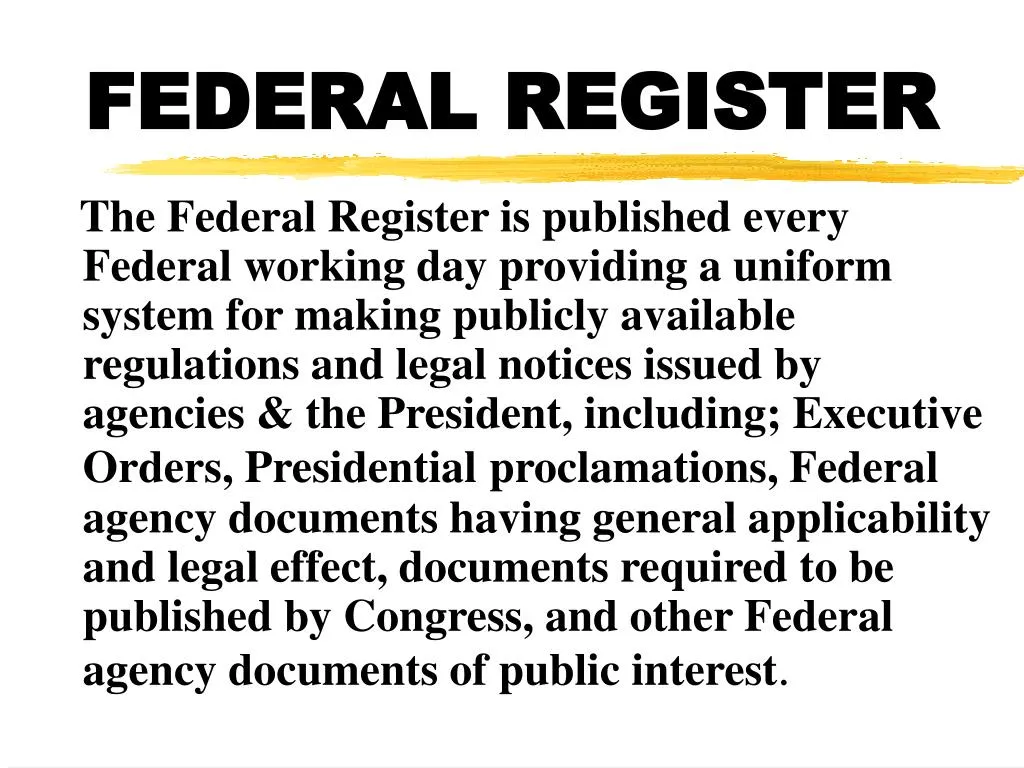 Photo: Federal Register, via image2.slideserve.com
The framers never envisioned this sprawling regulatory apparatus. When they designed our system of checks and balances, they assumed Congress would write the laws, the executive would enforce them, and courts would interpret them. They never imagined a fourth branch of government — the administrative state — that would combine all three functions under bureaucratic control.
The Constitutional Crisis Hidden in Plain Sight
The regulatory state operates on a simple but constitutionally dubious premise: Congress passes vague laws authorizing agencies to fill in the details. The Clean Air Act tells the EPA to regulate pollutants that "endanger public health." The Securities Exchange Act empowers the SEC to prevent "manipulative or deceptive" practices. The Occupational Safety and Health Act directs OSHA to ensure "safe and healthful" working conditions.
These broad delegations might sound reasonable until you realize what happens next. Unelected officials at these agencies don't just implement congressional intent — they effectively become lawmakers themselves, interpreting these vague mandates to create sweeping new rules that can reshape entire industries overnight.
Consider the EPA's Clean Power Plan, which attempted to force a nationwide transition away from coal-fired electricity generation. Congress never voted to shut down coal plants. The agency simply interpreted "endanger public health" broadly enough to justify a policy that would have fundamentally transformed America's energy infrastructure. When the Supreme Court struck down this regulatory overreach in West Virginia v. EPA, it wasn't just correcting an agency mistake — it was defending the constitutional principle that major policy decisions belong to elected officials, not bureaucrats.
 Photo: Supreme Court, via www.thepublicdiscourse.com
The Chevron Doctrine's Forty-Year Mistake
For four decades, the Chevron doctrine gave federal agencies extraordinary deference to interpret their own statutory authority. Under this precedent, courts were required to defer to agency interpretations of ambiguous laws, even when those interpretations stretched statutory language beyond recognition.
This judicial abdication turned agencies into super-legislators with virtually unchecked power. Why lobby Congress to change a law when you could simply petition an agency to reinterpret it? Why challenge regulations in court when judges were required to rubber-stamp agency decisions?
The Supreme Court's recent decision to overturn Chevron deference in Loper Bright Enterprises v. Raimondo represents the most significant constitutional victory for limited government in decades. By requiring courts to independently interpret statutory language rather than deferring to agency preferences, the Court restored the judiciary's constitutional role as a check on executive power.
But overturning Chevron is just the beginning. The real work of constitutional restoration requires Congress to reclaim its lawmaking authority.
The Numbers Don't Lie
The growth of the regulatory state isn't just a constitutional concern — it's an economic disaster. The Competitive Enterprise Institute estimates that federal regulations impose over $2 trillion in annual compliance costs on the American economy. That's roughly $15,000 per household, a hidden tax that hits working families hardest.
Small businesses bear a disproportionate burden. While large corporations can afford teams of lawyers to navigate regulatory complexity, small businesses often lack the resources to comply with ever-changing rules. The Small Business Administration found that regulatory compliance costs small businesses $12,000 per employee annually — nearly three times the per-employee cost for large firms.
This regulatory disparity doesn't just stifle entrepreneurship; it actively consolidates market power among established players who can afford compliance costs. When regulations favor big business at small business expense, the administrative state becomes a tool for corporate cronyism disguised as consumer protection.
The Democratic Deficit
Progressive defenders of the administrative state argue that congressional delegation is necessary because modern governance is too complex for elected officials to handle directly. This argument fundamentally misunderstands both democracy and expertise.
Democracy doesn't require elected officials to be technical experts on every policy detail. It requires them to make value judgments about competing priorities and trade-offs. Should we prioritize economic growth or environmental protection? How much safety regulation justifies higher consumer costs? These aren't technical questions that bureaucrats can answer objectively — they're inherently political choices that belong to voters and their representatives.
When agencies make these decisions instead, they remove democratic accountability from governance. Voters can't fire EPA administrators or SEC commissioners who impose unpopular policies. They can only hope that a future president might appoint different bureaucrats — a hope that often proves futile as agency cultures persist across administrations.
The Path Forward
Restoring constitutional governance requires more than judicial victories like Loper Bright. Congress must reassert its legislative authority through concrete reforms.
First, Congress should pass the REINS Act, requiring legislative approval for any regulation imposing costs exceeding $100 million. This simple reform would force lawmakers to take ownership of major regulatory decisions instead of hiding behind bureaucratic delegation.
Second, Congress should impose sunset clauses on all major regulations, requiring periodic reauthorization to prevent regulatory accumulation. Just as laws can be repealed, regulations should face regular democratic review.
Third, Congress should strengthen the Congressional Review Act by extending review periods and allowing expedited consideration of regulatory rollbacks. Lawmakers need practical tools to check administrative overreach.
Finally, Congress should clearly define agency authority in new legislation, ending the era of vague delegations that invite bureaucratic mission creep.
The Defining Battle
The fight against the administrative state isn't just another conservative policy priority — it's the prerequisite for every other constitutional reform. As long as unelected bureaucrats can effectively legislate through regulation, democratic governance remains a fiction.
The American people didn't elect the EPA to reshape the energy sector, the SEC to control corporate governance, or OSHA to dictate workplace policies. They elected Congress to make those decisions through the messy but accountable process of democratic legislation.
Restoring that accountability won't be easy, but it's essential for preserving both constitutional government and economic freedom. The administrative state has had forty years to prove its worth — the result is regulatory capture, economic stagnation, and democratic deficit that threatens the republic itself.
The invisible army of federal bureaucrats has governed America long enough; it's time to restore government of, by, and for the people.